
Intel
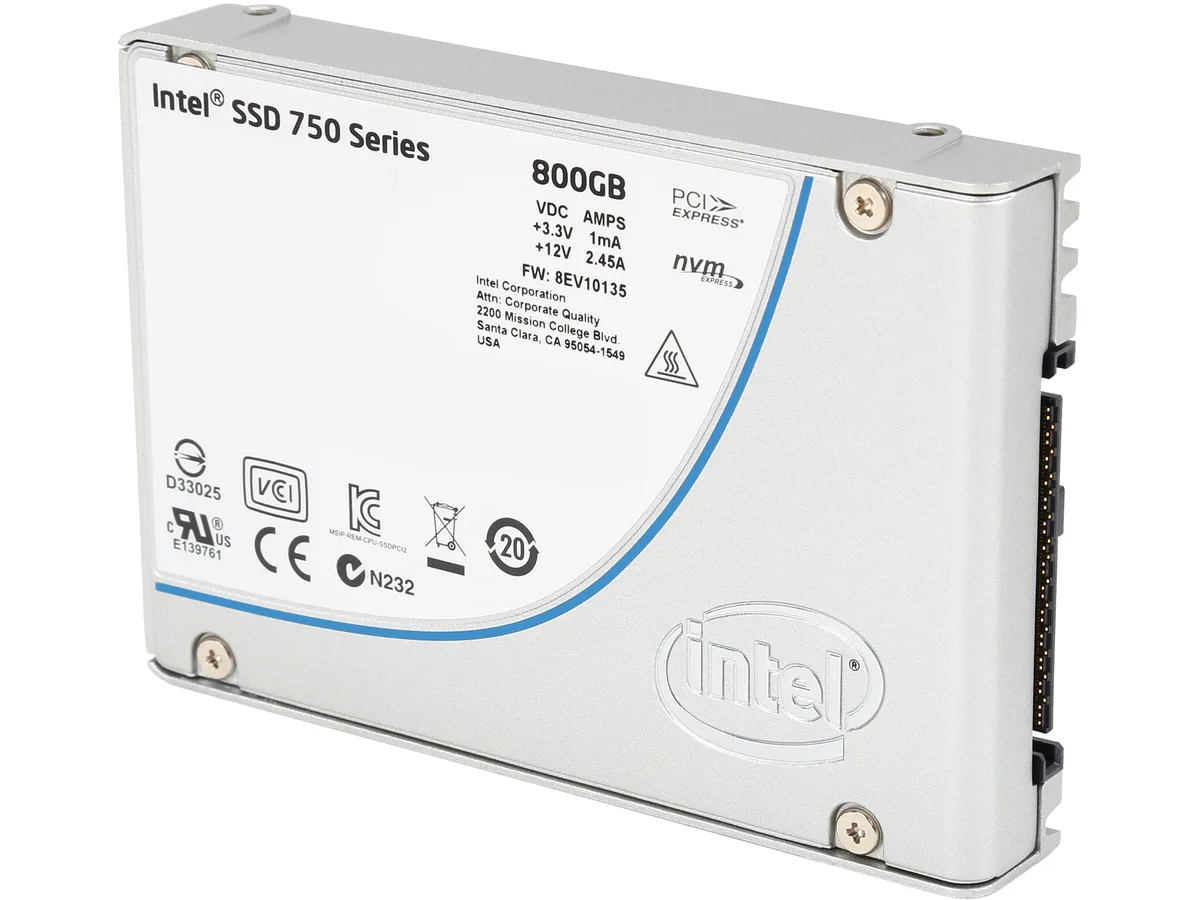
Intel 750 Series 2.5" 800GB PCIe 3.0 x4 Internal SSD SSDPE2MW800G4X1
- Internal Solid Stat…
- Consumer
$699.99$769.99−9%
0.00904543BTC
In stockWe take cryptocurrency — so the coins you hold can buy real hardware.Pay in crypto, spend it on real hardware. Free insured shipping worldwide over $399. Plain, unbranded boxes, sent from Germany.Free insured shipping over $399. Your rate is locked for 30 minutes once checkout opens.Rate locked 30 minutes. Every item sealed, serial-checked and covered by a 24-month warranty.Sealed, 24-month warranty.


Intel
400 GB AIC internal SSD using PCIe 3.0 x4 NVMe with up to 2,500 MB/s read and 1,200 MB/s write for workstation workloads
Options 400GB AIC
Struck-through versions exist but are not stocked here.
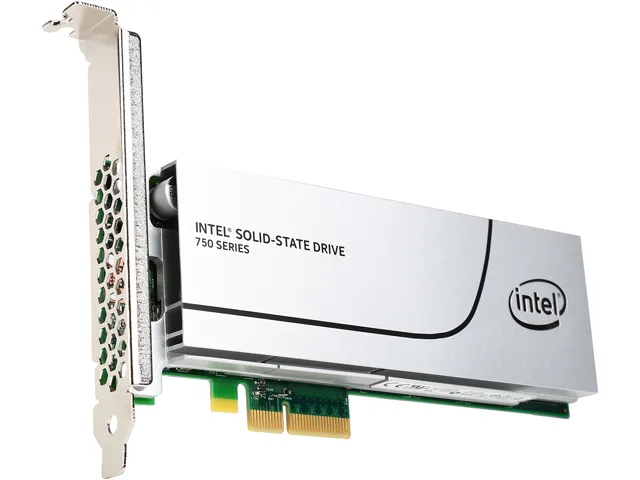
The Intel 750 Series SSDPEDMW400G4X1 is a 400GB add-in card solid state drive built for consumer desktops and workstations. It uses MLC memory and connects through a PCI-Express 3.0 x4 slot to deliver high throughput and low latency. The drive targets enthusiasts and professionals who need fast storage for demanding workloads.
The drive operates on the PCI-Express 3.0 x4 electrical interface using the NVMe protocol. Sequential reads reach up to 2500 MBps and sequential writes up to 1200 MBps. Random 4KB performance reaches 430000 IOPS read and 230000 IOPS write. Platform BIOS and operating system must support NVMe boot and driver stacks to achieve these figures.
The half-height card measures 68.90mm wide and 18.74mm tall, fitting standard PCIe slots with adequate clearance. Active power draw is 9W during reads and 12W during writes, so the slot and system cooling must handle the heat. Common issues include missing NVMe driver support in older install media and BIOS settings that disable the slot or default to legacy AHCI mode.
| Brand | Intel |
|---|---|
| Series | 750 Series |
| Model | SSDPEDMW400G4X1 |
| Device Type | Internal Solid State Drive (SSD) |
| Used For | Consumer |
| Form Factor | AIC |
| Capacity | 400GB |
| Memory Components | MLC |
| Interface | PCI-Express 3.0 x4 |
| Max Sequential Read | Up to 2200 MBps |
| Max Sequential Write | Up to 900 MBps |
| 4KB Random Read | Up to 430,000 IOPS |
| 4KB Random Write | Up to 230,000 IOPS |
| MTBF | 1,200,000 hours |
| Features | Performance Unleashed PCIe 3.0 X4 NVM Express SSD The Intel Solid State Drive (SSD) 750 Series is Intel's latest SSD for the high performance client and workstation storage market. Intel SSD 750 Series delivers the future of storage today with Intel's first PCIe based consumer SSD, combining four lanes of PCIe 3.0 with state-of-the-art NMV Express (NVMe) interface for truly amazing performance. |
| Power Consumption (Idle) | 4W |
| Power Consumption (Active) | Read: 9W Write: 12W |
| Operating Temperature | 0°C ~ +70°C |
| Height | 18.74mm |
| Width | 68.90mm |
| Depth | 168.00mm |
| Weight | 195.00g |
| Shipping weight | 0.39 kg |
| Package size | 241 × 159 × 32 mm |
Other versions of this model
Same family, different memory, cooler or clock — compare before you commit.
The 400 GB model is the only capacity offered in this AIC form factor, so it is the single choice for a PCIe 3.0 x4 add-in card.
It is the peak throughput the controller can sustain over four PCIe 3.0 lanes when reading large, contiguous blocks; real-world speeds depend on workload, queue depth and system cooling.
It uses a PCI-Express 3.0 x4 link with NVMe, limiting maximum sequential reads to 2 500 MB/s and writes to 1 200 MB/s while delivering up to 430 000 random read IOPS and 230 000 random write IOPS.
Also in this aisle
Same shelf, same checkout — eight coins and a 30-minute rate lock.
What you pay in, and what you read prices in.
Sent from your wallet at checkout
Display only — the catalogue is priced in USD
No currency matches that.
Pick the language the site speaks to you in.
New here?
Already have one?
There is no automatic reset: this shop sends no mail, so there is no one-time link to ask for. Leave the address on the account and it gets picked up by hand.
Request noted
Nothing is on its way to your inbox — this shop sends no mail at all. Someone picks these up by hand.
Remembered it?


