

Intel
Intel DC S3610 SSDSC2BX016T401 1.6TB 2.5" SATA enterprise SSD
- 2.5"
- 1.6TB
$1,299
0.01671793BTC
In stockWe take cryptocurrency — so the coins you hold can buy real hardware.Pay in crypto, spend it on real hardware. Free insured shipping worldwide over $399. Plain, unbranded boxes, sent from Germany.Free insured shipping over $399. Your rate is locked for 30 minutes once checkout opens.Rate locked 30 minutes. Every item sealed, serial-checked and covered by a 24-month warranty.Sealed, 24-month warranty.


Intel
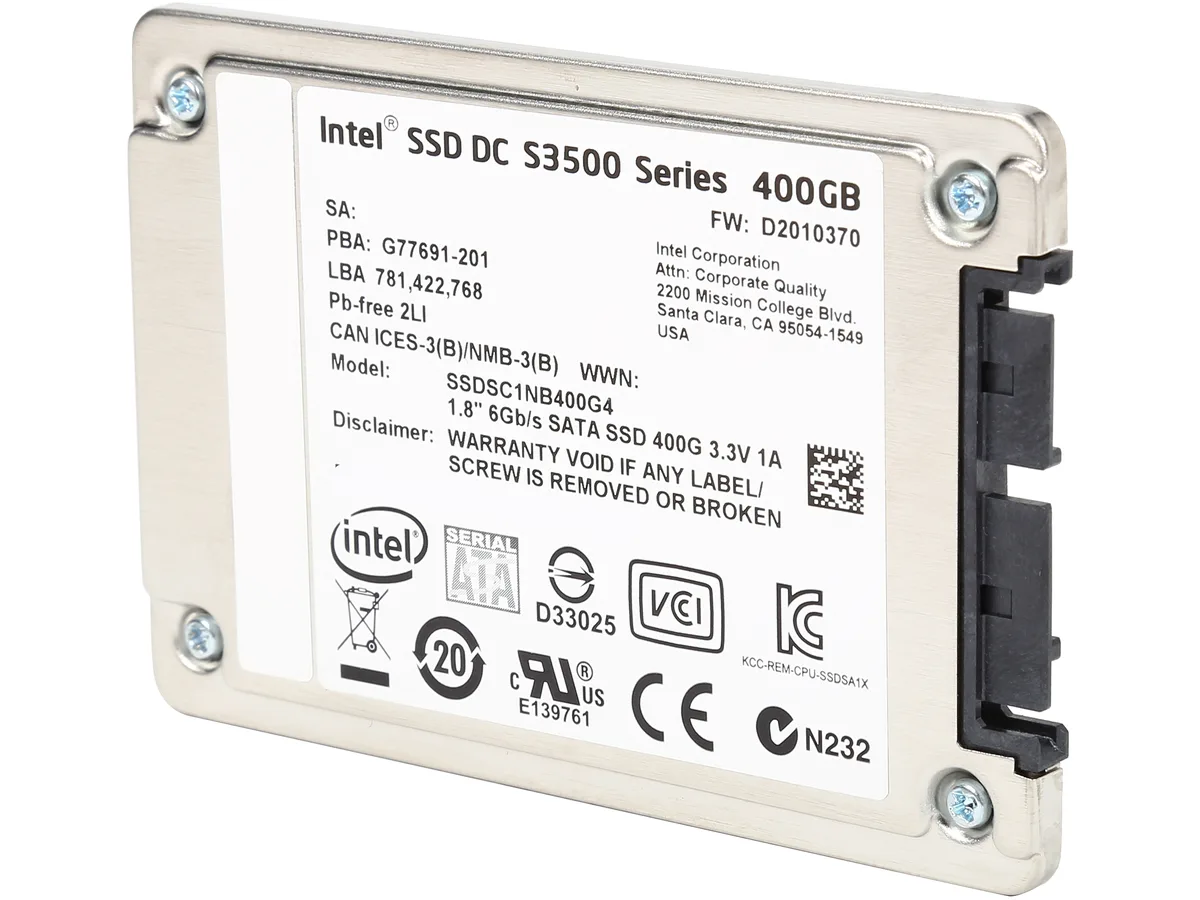
SATA III internal SSD with 400GB MLC capacity, up to 500MBps read and 380MBps write speeds, 75,000 random read IOPS, and power-loss data protection
The Intel SSD DC S3500 Series is a 400GB internal solid state drive built for data-centre workloads. It uses 20nm MLC NAND and a SATA III interface to deliver consistent read and write performance. The drive targets servers and storage arrays that need dependable endurance and full data-path protection. Power-loss protection and memory ECC help safeguard data during unexpected outages.
Replacing mechanical drives with this SSD removes rotational latency and raises sustained sequential reads to 500MBps and writes to 380MBps. Random 4KB reads reach 75,000 IOPS while writes hit 11,000 IOPS, cutting queue depth in transactional workloads. The jump is worth it when latency must drop below 65us and annualised failure rates need the 2,000,000-hour MTBF baseline. Standard endurance ratings back the transition for write-heavy applications.
The 400GB capacity comfortably handles operating-system volumes, logging partitions and caching tiers that stay within the 450TB lifetime write budget. Active power draw sits at 4.5W and idle at 0.6W, keeping thermal load low in dense enclosures. Operating temperatures from 0°C to 70°C and 1,000 G shock resistance give headroom for rack environments. Workloads that exceed the endurance ceiling or demand higher random write IOPS will need a larger or higher-tier drive.
| Brand | Intel |
|---|---|
| Series | SSD DC S3500 Series |
| Model | SSDSC1NB400G401 |
| Device Type | Internal Solid State Drive (SSD) |
| Capacity | 400GB |
| Memory Components | MLC |
| Interface | SATA III |
| Sustained Sequential Read | Up to 500MBps |
| Sustained Sequential Write | Up to 380MBps |
| 4KB Random Read | Up to 75,000 IOPS |
| 4KB Random Write | Up to 11,000 IOPS |
| Read Latency | 50us |
| Write Latency | 65us |
| MTBF | 2,000,000 hours |
| Features | Features of the IntelSSD DC S3500 Series include: Standard Endurance 20nm MLC NAND Up to 450TB written for life of drive Data Protection Features Full data path protection Memory ECC Power loss data protection 256 bit AES encryption Quality & Reliability Intel validation, system compatibility, and support |
| Power Consumption (Idle) | 0.6W |
| Power Consumption (Active) | 4.5W |
| Operating Temperature | 0°C ~ +70°C |
| Max Shock Resistance | 1,000 G at 0.5 msec |
| Height | 1.000 |
| Weight | 37g |
| Shipping weight | 0.07 kg |
| Package size | 155 × 124 × 23 mm |
The drive has a standard 2.5-inch form factor with a height of 1.000 inches, fitting typical 2.5-inch drive bays and caddies using SATA data and power connectors.
Connect the SATA data and power cables, secure the drive in a 2.5-inch bay, then enable AHCI mode in the system BIOS for full SATA III performance; skipping AHCI is the common oversight.
The drive is rated for up to 450TB written over its life; with typical mixed workloads this translates to several years before the MLC NAND reaches its endurance limit.
Also in this aisle
Same shelf, same checkout — eight coins and a 30-minute rate lock.
What you pay in, and what you read prices in.
Sent from your wallet at checkout
Display only — the catalogue is priced in USD
No currency matches that.
Pick the language the site speaks to you in.
New here?
Already have one?
There is no automatic reset: this shop sends no mail, so there is no one-time link to ask for. Leave the address on the account and it gets picked up by hand.
Request noted
Nothing is on its way to your inbox — this shop sends no mail at all. Someone picks these up by hand.
Remembered it?


