Micron Technology, Inc.
Micron Technology, Inc. MT4JTF12864AZ-1G4D1 1GB DDR3 1333 Desktop RAM
- 1GB
- DDR3 1333 (PC3 1060…
$28.99
0.00037246BTC
In stockWe take cryptocurrency — so the coins you hold can buy real hardware.Pay in crypto, spend it on real hardware. Free insured shipping worldwide over $399. Plain, unbranded boxes, sent from Germany.Free insured shipping over $399. Your rate is locked for 30 minutes once checkout opens.Rate locked 30 minutes. Every item sealed, serial-checked and covered by a 24-month warranty.Sealed, 24-month warranty.


MSI
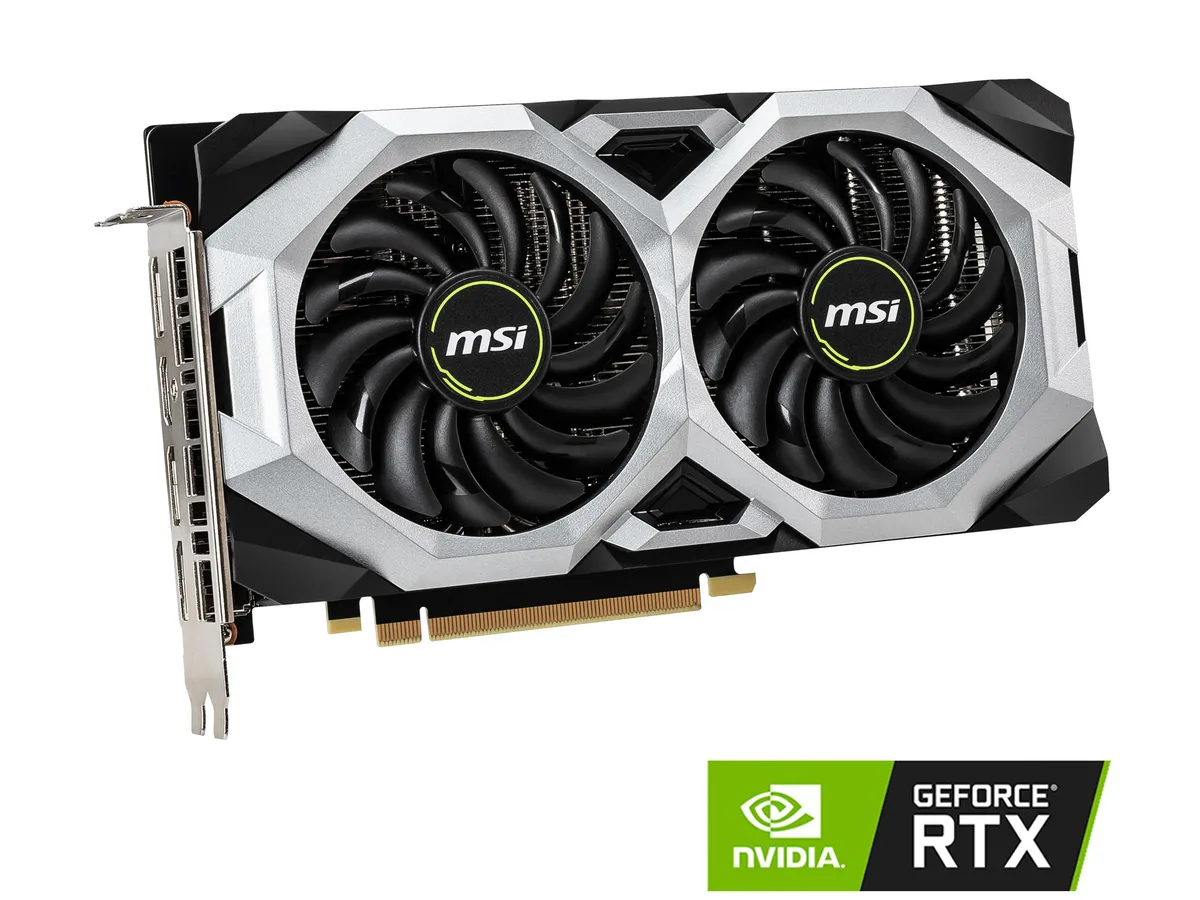
GeForce RTX 2070 GPU with 2304 CUDA cores, 8 GB 256-bit GDDR6 memory, 1410 MHz base and 1620 MHz boost clocks, plus HDMI 2.0b and three DisplayPort 1.4 outputs for 7680×4320 resolution
The MSI RTX 2070 Ventus 8G is a GeForce RTX 2070 graphics card with 8GB of GDDR6 memory on a 256-bit bus. It connects through a PCI Express 3.0 x16 slot and delivers a core clock of 1410 MHz with a boost clock of 1620 MHz. The board measures 8.90 inches by 5.04 inches and occupies two expansion slots.
This card fits builders who need 2304 CUDA cores for compute workloads or gaming at high resolutions up to 7680 x 4320. It supports four simultaneous displays through one HDMI 2.0b port and three DisplayPort 1.4 connectors. Buyers who want more memory capacity or a newer GPU architecture should look at something else.
The dual-slot cooler and standard display outputs let the card drop into most ATX cases without extra adapters or brackets. DirectX 12 and OpenGL 4.5 support are included in the driver package, so no separate software install is required for current APIs. Virtual reality headsets work immediately over the provided ports.
| Brand | MSI |
|---|---|
| Model | RTX 2070 Ventus 8G |
| Interface | PCI Express 3.0 x16 |
| Chipset Manufacturer | NVIDIA |
| GPU Series | NVIDIA GeForce RTX 20 Series |
| GPU | GeForce RTX 2070 |
| Core Clock | 1410 MHz |
| Boost Clock | 1620 MHz |
| CUDA Cores | 2304 |
| Effective Memory Clock | 14 Gbps |
| Memory Size | 8GB |
| Memory Interface | 256-Bit |
| Memory Type | GDDR6 |
| DirectX | DirectX 12 |
| OpenGL | OpenGL 4.5 |
| Multi-Monitor Support | 4 |
| HDMI | 1 x HDMI 2.0b |
| DisplayPort | 3 x DisplayPort 1.4 |
| Max Resolution | 7680 x 4320 |
| Virtual Reality Ready | Yes |
| Thermal Design Power | 175W |
| System Requirements | Recommended PSU: 550W |
| Recommended PSU Wattage | 550W |
| Power Connector | 8-Pin |
| HDCP Ready | 2.2 |
| Features | TORX Fan 2.0/Dispersion fan blade: Steep curved blade accelerating the airflow./Traditional fan blade: Provides steady airflow to massive heat sink below.//Afterburner Overclocking Utility/Wireless control through Android/iOS devices./Predator: In-game video recording./Kombustor: DirectX12 benchmark./Supports multi-GPU setups.//NVIDIA G-SYNC and HDR/Get smooth, tear-free gameplay at refresh rates up to 240 Hz, plus HDR, and more. This is the ultimate gaming display and the go-to equipment for enthusiast gamers.//GeForce RTX VR/By combining advanced VR rendering, real-time ray tracing |
| Max GPU Length | 226 mm |
| Card Dimensions (L x H) | 8.90" x 5.04" |
| Slot Width | 2 Slots |
Yes, the card uses a PCI Express 3.0 x16 interface and occupies a dual-slot width, so the board must provide that slot and enough clearance for the 8.90" length.
Absolutely — both interfaces are backward compatible, so older monitors will run at their native resolutions up to the card's 7680 x 4320 maximum.
Open GPU-Z or MSI Afterburner; the sensors tab will show the real-time core frequency moving between 1410 MHz at idle and up to 1620 MHz under load.
Also in this aisle
Same shelf, same checkout — eight coins and a 30-minute rate lock.
What you pay in, and what you read prices in.
Sent from your wallet at checkout
Display only — the catalogue is priced in USD
No currency matches that.
Pick the language the site speaks to you in.
New here?
Already have one?
There is no automatic reset: this shop sends no mail, so there is no one-time link to ask for. Leave the address on the account and it gets picked up by hand.
Request noted
Nothing is on its way to your inbox — this shop sends no mail at all. Someone picks these up by hand.
Remembered it?