Micron Technology, Inc.
Micron Technology, Inc. MT4JTF12864AZ-1G4D1 1GB DDR3 1333 Desktop RAM
- 1GB
- DDR3 1333 (PC3 1060…
$28.99
0.00037515BTC
In stockWe take cryptocurrency — so the coins you hold can buy real hardware.Pay in crypto, spend it on real hardware. Free insured shipping worldwide over $399. Plain, unbranded boxes, sent from Germany.Free insured shipping over $399. Your rate is locked for 30 minutes once checkout opens.Rate locked 30 minutes. Every item sealed, serial-checked and covered by a 24-month warranty.Sealed, 24-month warranty.


MSI
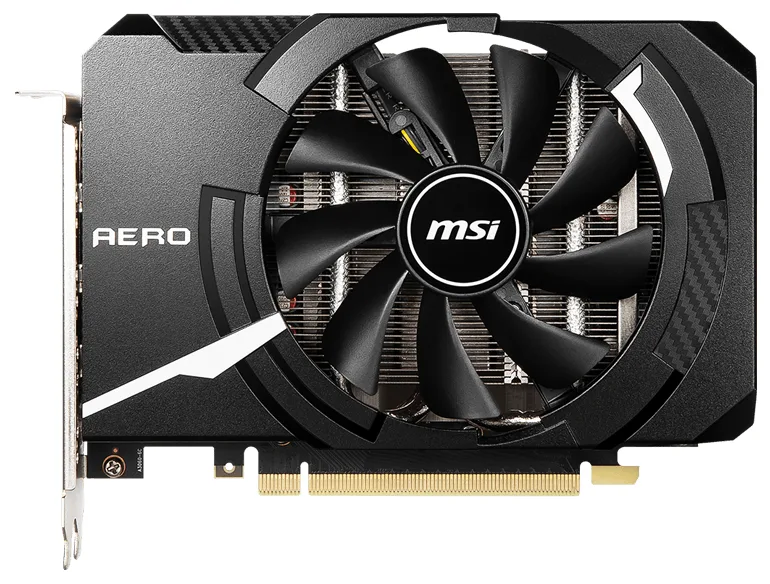
Single-fan graphics card with 8GB GDDR6 memory, 2560 CUDA cores and a 1807 MHz boost clock for compact PC builds
The MSI RTX 3050 AERO ITX 8G OC is a single-fan graphics card built for small form factor systems and HTPC cases. It connects through a PCI Express 4.0 slot and draws up to 130W through one 8-Pin power connector. The Ampere GPU delivers 2560 CUDA cores with a 1807 MHz boost clock.
This card fits builders who need RTX features in a tight chassis and want to drive up to four displays via HDMI 2.1 and three DisplayPort 1.4 outputs. It is not intended for 4K gaming or workloads that require more than 8GB of video memory or a wider memory bus.
The 8GB GDDR6 frame buffer on a 128-bit interface running at 14 Gbps effective clock sets the performance ceiling for texture-heavy titles and productivity tasks. If your workflow needs more bandwidth or capacity, look at cards with a larger memory interface.
| Brand | MSI |
|---|---|
| Model | RTX 3050 AERO ITX 8G OC |
| Interface | PCI Express 4.0 |
| Chipset Manufacturer | NVIDIA |
| GPU Series | NVIDIA GeForce RTX 30 Series |
| GPU | GeForce RTX 3050 |
| Architecture | Ampere |
| Boost Clock | 1807 MHz |
| CUDA Cores | 2560 |
| Effective Memory Clock | 14 Gbps |
| Memory Size | 8GB |
| Memory Interface | 128-Bit |
| Memory Type | GDDR6 |
| DirectX | DirectX 12 Ultimate |
| OpenGL | OpenGL 4.6 |
| Multi-Monitor Support | 4 |
| HDMI | 1 x HDMI 2.1 |
| DisplayPort | 3 x DisplayPort 1.4 |
| Max Resolution | 7680 x 4320 |
| Cooler | Single Fan |
| Thermal Design Power | 130W |
| Recommended PSU Wattage | 550W |
| Power Connector | 8-Pin |
| HDCP Ready | Yes |
| Features | Small Form Factor Design Perfect for small form factor systems and HTPC. Custom fan design with a unique curve to enhance heat dissipation. Copper heatpipes maximize heat transfer from the surface of the baseplate for better cooling. MSI Center The exclusive MSI Center software lets you monitor, tweak, and optimize MSI products in real-time. Afterburner Overclocking Utility OC Scanner: An automated function finds the highest stable overclock settings. On Screen Display: Provides real-time information of your system's performance. Predator: In-game video recording. |
| Max GPU Length | 172 mm |
| Card Dimensions (L x H) | 6.77" x 4.92" |
| Shipping weight | 0.82 kg |
| Package size | 305 × 224 × 70 mm |
The compact single-fan design is built for small-form-factor systems and HTPCs, so it fits in tight chassis where full-length cards cannot.
Insert the required 8-pin PCIe power connector fully until it clicks; the card draws up to 130 W and the 550 W PSU recommendation assumes that connector is properly engaged.
Re-paste every two to three years or if GPU temperatures rise noticeably under load; the copper heatpipes transfer heat from the baseplate, so fresh paste maintains efficient dissipation.
Also in this aisle
Same shelf, same checkout — eight coins and a 30-minute rate lock.
What you pay in, and what you read prices in.
Sent from your wallet at checkout
Display only — the catalogue is priced in USD
No currency matches that.
Pick the language the site speaks to you in.
New here?
Already have one?
There is no automatic reset: this shop sends no mail, so there is no one-time link to ask for. Leave the address on the account and it gets picked up by hand.
Request noted
Nothing is on its way to your inbox — this shop sends no mail at all. Someone picks these up by hand.
Remembered it?